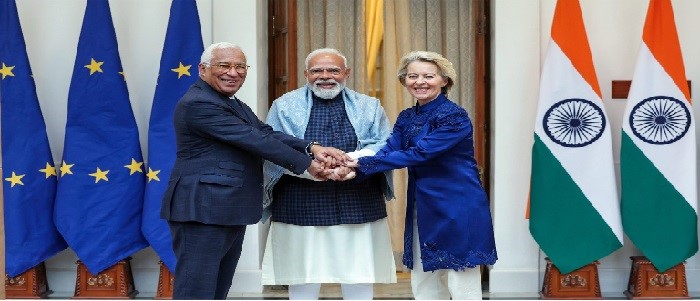
India and the European Union have concluded and signed a landmark Free Trade Agreement (FTA) at the India EU Summit in New Delhi on 27 January 2026, positioning it as one of the largest trade deals by market size and strategic heft. What makes this deal commercially important is its breadth. It combines large-scale tariff liberalisation in goods with commitments that affect how trade actually happens, including customs facilitation, regulatory cooperation, and services market access. The Indian Government’s release highlights preferential access across 97% of EU tariff lines covering 99.5% of trade value, while also setting out India’s tariff line coverage offered to the EU.
1. What the FTA covers in brief
Scope and architecture
- Goods: Deep tariff elimination and phased reductions, with carve-outs and tariff rate quotas (TRQs) for sensitive lines.
- Services: Market access improvements are part of the deal, alongside easier pathways for cross border supply in select sectors.
- Trade facilitation: Emphasis on simplified customs procedures and predictability for businesses.
- Standards and sustainability: The EU has framed the agreement as upholding European standards and sustainable trade commitments, while some climate-linked issues, such as CBAM relief, remain unresolved according to reporting.
Market size and strategic backdrop
The EU and India together account for close to a quarter of global GDP and a massive consumer base, which both sides have explicitly highlighted in official and media statements.
2. India EU trade: where things stand today
Trade in goods
In 2024–25, India’s bilateral trade in goods with the EU stood at INR 11.5 Lakh Crore (USD 136.54 billion) with exports worth INR 6.4 Lakh Crore (USD 75.85 billion) and imports amounting to INR 5.1 Lakh Crore (USD 60.68 billion).
Trade in services
EU-India services trade has also scaled up materially. The Council’s published infographic places 2024 services trade at over €66 billion, with EU imports around €37.4 billion and EU exports around €29.2 billion.
3. Major 10 items of export from India to the EU
Below are the Top 10 exports from India to the EU in 2024, category-wise:-
| Category | % share in India’s exports to the EU |
|---|---|
| Mineral Fuels and Oils | 19.8% |
| Electrical and Electronic Equipment | 14.8% |
| Organic Chemicals | 6.7% |
| Machinery and Mechanical Equipment | 6.6% |
| Apparel | 6% |
| Iron and Steel | 4.0% |
| Pharmaceuticals | 3.9% |
| Gems, Precious Metals, and Jewellery | 3.3% |
| Automobiles and Auto Parts | 2.9% |
| Iron and Steel articles | 2.4% |
India’s EU story is already a mix of manufacturing, processing, and value-dense categories such as pharmaceuticals and gems.
4. Duty concessions and exemptions: what changes
The deal’s tariff design matters more than the headline percentage, because exporters win only when the relevant HS lines move quickly and rules of origin are workable.
A. EU market access for India
India’s official release sets out a structured EU tariff outcome:
- Preferential access across 97% of EU tariff lines covering 99.5% of trade value.
- Immediate duty elimination for 70.4% of tariff lines covering 90.7% of India’s exports, explicitly naming labour-intensive sectors such as textiles, leather and footwear, tea, coffee, spices, sports goods, toys, gems and jewellery, and certain marine products.
- Zero duty over 3 to 5 years for a further set of tariff lines, including certain marine products and processed foods.
- Preferential access via tariff reductions or TRQs for a smaller slice, including TRQs for cars, steel, and certain shrimp and prawn products.
B. India’s tariff offer to the EU
India’s release also summarises India’s offer:
- 92.1% of tariff lines covering 97.5% of EU exports.
- 49.6% of tariff lines with immediate duty elimination, and 39.5% with phased elimination over 5, 7, and 10 years.
C. High salience concessions highlighted in reporting
Reporting on the deal highlights specific, politically sensitive lines:
- Automobiles: Tariffs on EU vehicles in India fall from as high as 110% to 10% over five years, within a quota framework.
- Alcohol: Duties on wine and spirits are set to reduce materially, with reporting indicating sharp cuts (exact schedule varies by product line).
5. Sectors likely to benefit most
India’s likely winners
India’s key labour-intensive sectors, currently facing EU import duties ranging roughly 4% to 26%, are expected to move to zero duty from entry into force for a very large share of export value.
Practical sectoral beneficiaries include:
- Textiles and apparel: Immediate duty elimination for a major share of export value, improving price competitiveness and order retention.
- Leather and footwear: Similar immediate relief, likely to support MSME heavy clusters.
- Gems and jewellery: Tariff advantages plus faster customs outcomes can improve working capital cycles.
- Marine products: A large part of the sector is positioned for zero duty, with some lines phased and some handled via quotas.
- Chemicals and pharmaceuticals: Already prominent in the export basket, with scope to scale volumes under preferential access.
- Electronics and engineering goods: Smartphones already top the chart, and facilitation chapters can matter as much as tariffs for time-sensitive shipments.
EU’s likely winners in India
From the EU framing and reporting, large winners include:
- Automotive and premium mobility: A clear headline gain due to large tariff compression with quota discipline.
- Machinery, industrial inputs, and chemicals: These map directly to what the EU already exports at scale to India, and India’s tariff line coverage suggests broad opening.
- Wine and spirits: A politically watched consumer segment with headline tariff reductions.
- Services suppliers: The EU factsheet stresses improved access in services and simpler customs procedures, which often benefits EU SMEs disproportionately.
6. Conclusion and likely implementation date
This FTA is best understood as two things at once.
First, it is a tariff deal, where the most valuable outcomes are not the headline percentages but the speed and certainty with which priority HS lines reach zero duty, and the ease with which exporters can satisfy rules of origin without losing the preference. Second, it is an operating system upgrade for India EU commerce, by promising more predictable procedures, more structured dispute and consultation mechanisms, and broader cooperation that supports investment and supply chain integration.
Likely implementation date
The agreement still needs legal vetting and ratification steps, with an expectation that it could be implemented within about one year, which would point to 2027 as a realistic entry into force window, subject to domestic and EU level approvals and any provisional application decisions.